Transportation Master Plan
Help Plan for a Safe and Connected Community!
Port Alberni is creating a Transportation Master Plan with input from the community!
The Transportation Master Plan (TMP) will establish the long-term vision for our city’s transportation network. The TMP will build upon previous efforts, including the 2014 Active Transportation Plan (see Project Documents - Phase 1 for details), by reviewing, revising, updating, and integrating city-identified transportation projects to create a comprehensive roadmap for maintaining, enhancing, and expanding Port Alberni's transportation infrastructure.
Through this plan, the City aims to create a transportation network that serves both current and future generations while supporting broader financial and strategic goals. We look forward to achieving a multimodal network that is safe and accessible for all users and meets the needs of residents and visitors alike for years to come!
Latest Updates
Read the second What We Heard summary report.
November 18, 2026: You are invited to the 4th annual Connect with Your City open house event, featuring the City's Master Plans and the TMP.
TMP Alignment with City Plans
The TMP aligns with the City’s Corporate Strategic Plan goal of creating a transportation network that supports the city’s vision for a connected, accessible, and sustainable community.
The TMP is also closely integrated with the ongoing work on the Parks, Recreation, and Culture Master Plan. Together, these plans will align efforts to enhance active transportation networks, enabling the Parks, Recreation, and Culture and Infrastructure Services departments to develop a cohesive network and route plan that links road corridors, trails, and multi-use pathways (MUPs) throughout the city's parklands and natural areas.
Public Input
Connect with your City Open House
- November 18, 2026
- Echo '67 Community Centre
- 4255 Wallace Street
The TMP will be part of the fourth annual Connect with your City open house event. Before that time you are still welcome to share your feedback with us. Reach out to us at master_plans@portalberni.ca. Public input plays a vital role in shaping the TMP, ensuring that the transportation network reflects our community’s priorities and needs for a connected, efficient, and inclusive system. Your participation is key to shaping the future of our transportation network.
How We Heard From You
- Master Planning Open House (March 2025)
- "Connect with Your City" Open House and Master Plan Presentations (November 2025)
- Public Survey #1 (Spring 2025)
- Public Survey #2 (Winter 2026)
- Targeted surveys to local industries
- Targeted consultation with interest groups
Planning Process & Timeline
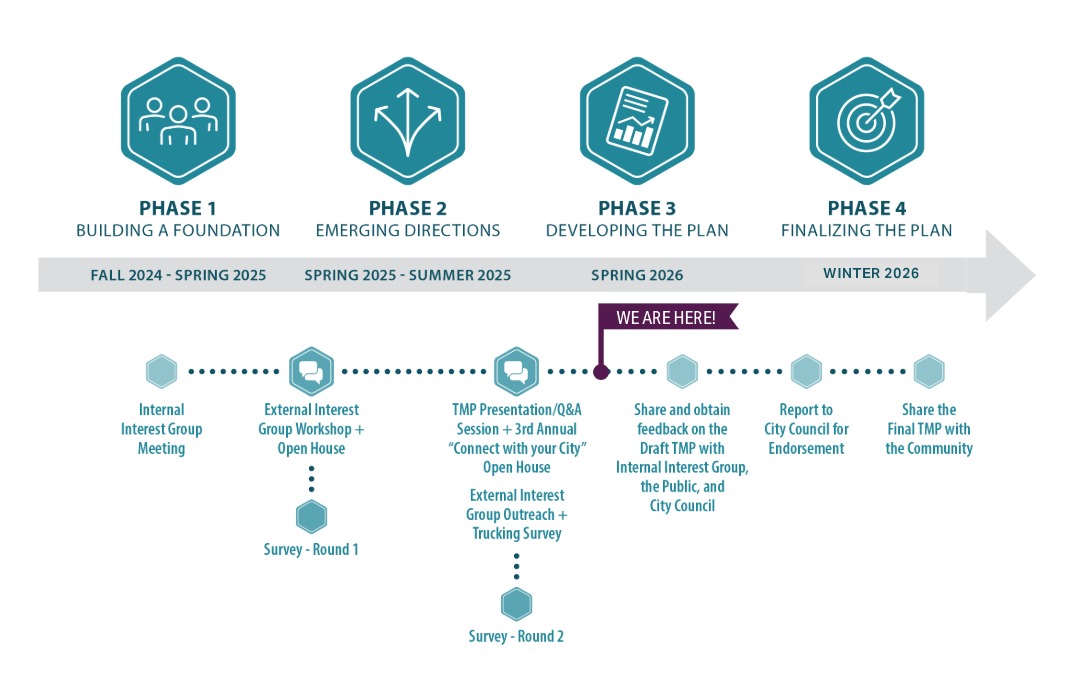
The planning process started in Fall 2024 and takes place in four phases (below). We are now entering phase three of the planning process, with completion anticipated in Fall 2026. During each phase, the community has had opportunities to get involved through events, surveys, and other engagement opportunities.
Next Steps
The draft TMP will be shared with internal interest groups, the public, and City Council for their feedback. The report will then be presented to City Council, and the final TMP will be shared with the community.
-
This information below presents the draft Transportation Network Plans for TMP Round 2. The materials are provided here to give a more comprehensive view of the proposed network and its components.
The plans are illustrated through maps to help situate the network within its broader context and to support a clearer understanding of how the system functions as a whole.
We encourage you to review this brief before completing the survey, as it provides important background and context that may be difficult to capture within the survey format alone.
Once you have reviewed the information, you may proceed to the survey to share your feedback on the draft plans.Draft Transportation Network Plans
Draft Pedestrian Network Map
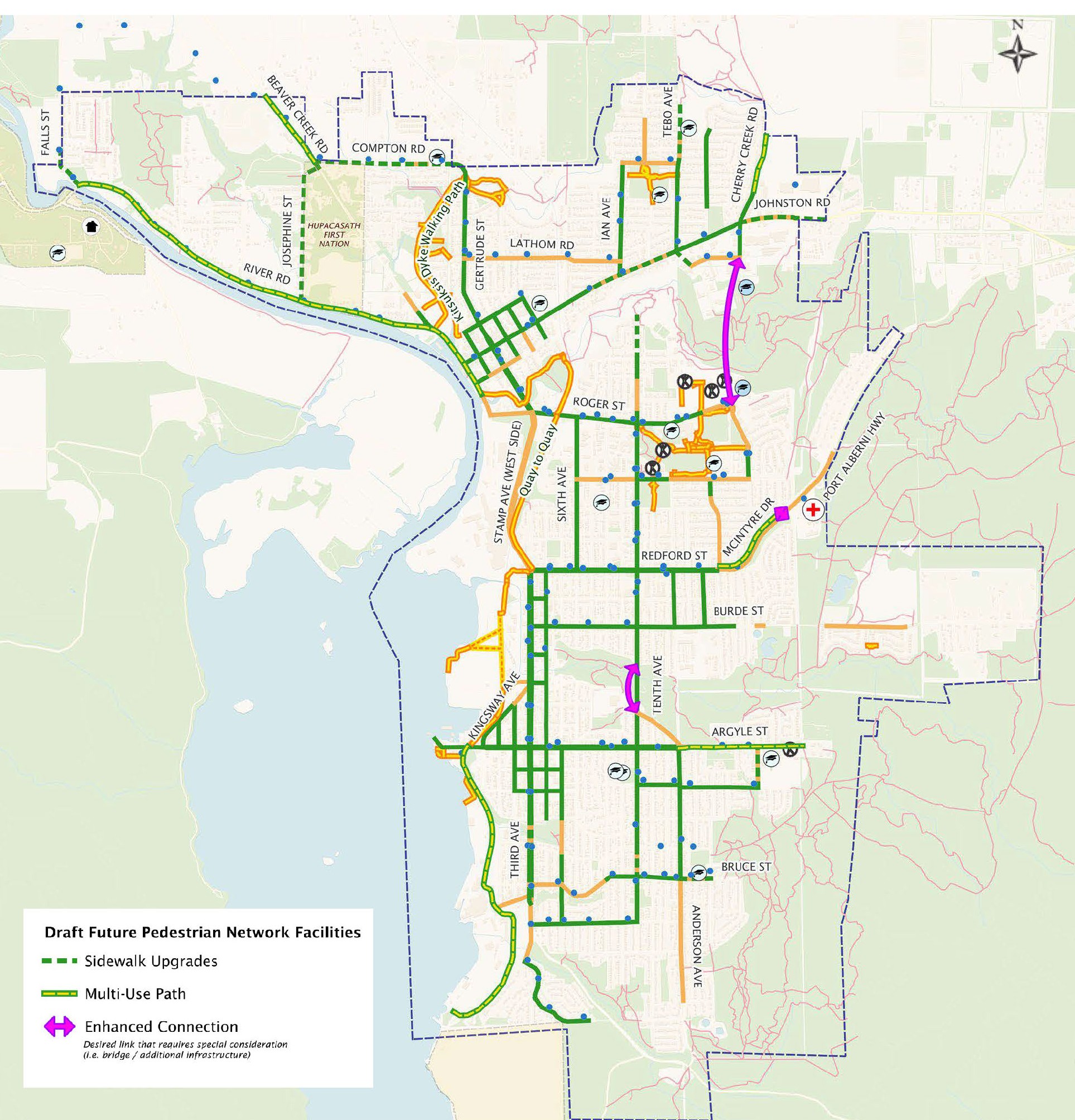
The Draft Pedestrian Network Plan focuses on strengthening and completing the walking network by addressing key gaps, improving pedestrian access at bus stops, and creating safe, comfortable routes to schools, parks, and community facilities. A map of the Draft Pedestrian Network Plan is provided below.
The plan identifies three types of walking improvements:
- Sidewalk Upgrades: Improve streets with narrow sidewalks, sidewalks on only one side, or missing sidewalks altogether, helping to create safer and more accessible walking environments. The Draft Pedestrian Network Plan considers providing new sidewalks along one or both sides of sections of Johnston Road, Josephine Street, Compton Road, and Tenth Avenue, among others. Widening sidewalks in commercial areas to activate storefronts and enhance the public realm in sections around Johnston Road, Third Avenue, Tenth Avenue, Roger Street, and Redford Street is also being considered.
- Multi-use Pathways: Extend existing pathways and introduce new shared connections in areas where both pedestrians and people cycling would benefit. The Draft Pedestrian Network Plan considers extending the Quay-to-Quay pathway with multi-use pathways along River Road and Harbour Road, as well as a new multi-use pathways along sections of Cherry Creek Road (north of Michigan Road, where there are a missing sidewalks on both sides), McIntyre Drive (providing a connection parallel to Port Alberni Highway), and Argyle Street (east of Anderson Avenue, where there is a missing sidewalk on one side).
- Enhanced Pedestrian Connections: Address locations where a new active transportation link is needed, but where the appropriate solution may vary, such as pedestrian overpasses or off-street pathways. The Draft Pedestrian Network Plan identifies the need for a Roger Creek crossing (for active transportation), an enhanced cycling connection across the Tenth Avenue “Dip” between Dunbar Street and North Park Drive, and a new connection crossing Port Alberni Highway to connect the potential McIntyre Drive multi-use pathway to the hospital.
Draft Bicycle Network Map
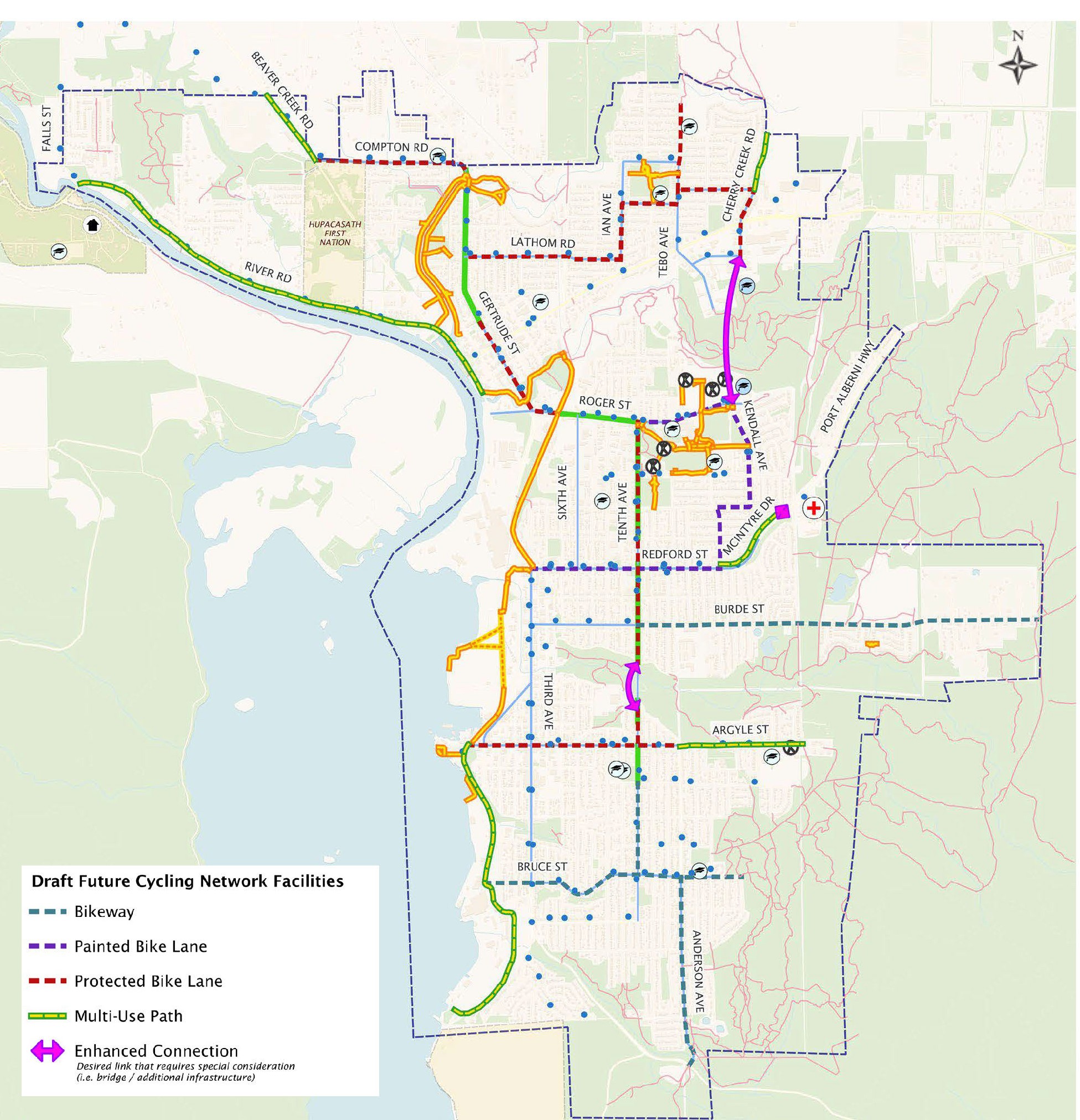
The Draft Cycling Network Plan focuses on strengthening and completing the cycling network by filling key gaps, improving existing facilities, and providing safe, comfortable biking routes to schools, parks, and community facilities. A map of the Draft Bicycle Network Plan is provided below.
The plan identifies several types of cycling improvements to support riders of varying ages and abilities:
- Neighbourhood Bikeways: Use low-traffic, low-volume streets where people cycling share the roadway with vehicles, supported by traffic calming measures that reduce vehicle speeds and improve comfort and safety. The Draft Bicycle Network Plan identifies sections of Burde Street, Bruce Street, Tenth Avenue (south of China Creek Road), and Anderson Avenue as potential neighbourhood bikeways.
- Painted Bike Lanes: Provide dedicated space for cyclists along roadways where right-of-way constraints limit opportunities for more separated facilities and typically function as secondary cycling routes. The Draft Bicycle Network Plan identifies sections of Redford Street and Roger Street (east of Tenth Avenue)—connected through Kendall Avenue, Maitland Street, and Wood Avenue—as potential routes with painted bike lanes.
- Protected Bike Lanes: Offer physically separated space for cyclists along primary routes where space allows, creating a higher level of comfort and safety. The Draft Bicycle Network Plan identifies sections of Argyle Street, Tenth Avenue, Gertrude Street, Lathom Road, Compton Road, Tebo Avenue, and Cherry Creek Road, among others, as potential routes with protected bike lanes.
- Multi-Use Pathways: Extend existing shared-use pathways and provide off-street connections that serve both pedestrians and cyclists, consistent with those identified in the Pedestrian Network Plan. The Draft Bicycle Network Plan considers extending the Quay-to-Quay pathway with multi-use pathways along River Road and Harbour Road, as well as a new multi-use pathways along sections of Cherry Creek Road (north of Michigan Road, where there are a missing sidewalks on both sides), Mcintyre Drive (providing a connection parallel to Port Alberni Highway), and Argyle Street (east of Anderson Avenue, where there is a missing sidewalk on one side). These connections are consistent with what is proposed in the Draft Pedestrian Network Plan.
- Enhanced Cycling Connections: Address locations where new cycling links are needed but where the appropriate solution may vary, such as new bridges, overpasses, underpasses, or off-street connections, consistent with those identified in the pedestrian network. The Draft Bicycle Network Plan identifies the need for a Roger Creek crossing (for active transportation), an enhanced cycling connection across the Tenth Avenue “Dip” between Dunbar Street and North Park Drive, and a new connection crossing Port Alberni Highway to connect the potential McIntyre Drive multi-use pathway to the hospital. These connections are consistent with what is proposed in the Draft Pedestrian Network Plan.
 Share Survey 2 - Closed on Facebook Share Survey 2 - Closed on X (formerly Twitter) Share Survey 2 - Closed on Linkedin Email Survey 2 - Closed link
-

Phone 250-720-2830 Email Master_Plans@portalberni.ca
-
 What We Heard - Round 2 Public Engagement - May 2026 (7.55 MB) (pdf)
-
 Phase 1 Documents
-
BC Transit Future Service Plan Port Alberni 2025 - Presentation (1.87 MB) (pdf)
-
City of Port Alberni - Active Transportation - Final Report (2014) - 2014-06-24.pdf (4.83 MB) (pdf)
-
TMP - What We Heard Report - Public Engagement - Phase 1 - July 2025.pdf (13.1 MB) (pdf)
-
Phase 1 - Open House Info Boards - Transportation Master Plan (9.81 MB) (pdf)
-
-
Phase 2 Documents
-
Transportation Master Plan FAQs.pdf (73 KB) (pdf)
-
Draft Pedestrian Network Plan (879 KB) (pdf)
-
Draft Cycling Network Plan (821 KB) (pdf)
-
Transportation Master Plan Survey 2 Brief.pdf (1.15 MB) (pdf)
-
Phase 2 - Open House Info Boards - Nov 26 2025 (7.72 MB) (pdf)
-
Phase 2 - Presentation - Nov 26 2025 (4.08 MB) (pdf)
-

